The Lid-Peeking Habit That's Quietly Adding Hours to Your Slow Cooker Recipe
Quick Answer: Lifting a slow cooker lid releases built-up heat and steam that can take 15-20 minutes to fully recover, meaning a few curious peeks during a cook can add an hour or more to the total cooking time without anyone realizing why the dish is taking longer than the recipe stated.
The recipe said 6 hours. It’s been 7, and dinner still isn’t quite done. The ingredients weren’t the problem — the lid probably came off more times than it seems worth mentioning.

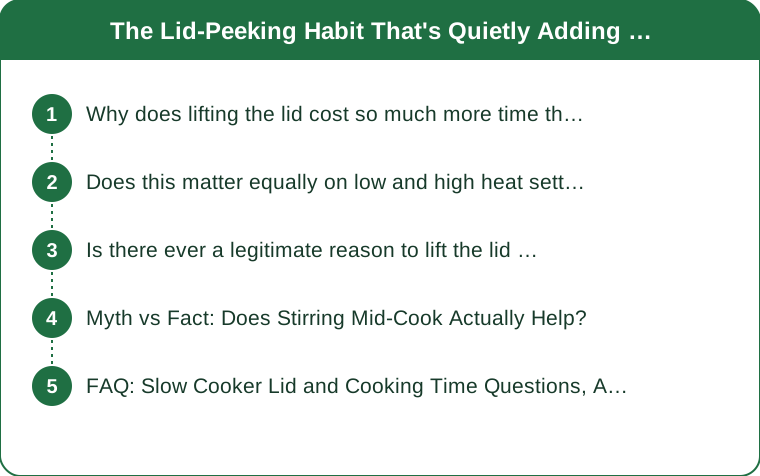
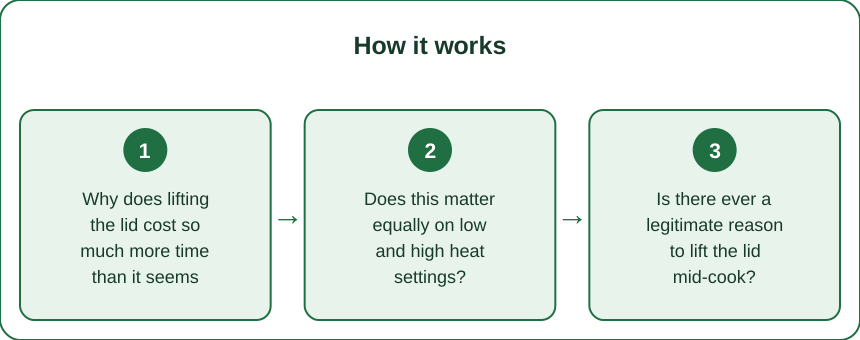
Why does lifting the lid cost so much more time than it seems like it should?
A slow cooker relies on a sealed, gradually building heat and steam environment to cook food evenly at a low temperature — unlike an oven, which recovers temperature relatively quickly after the door opens, a slow cooker’s lower wattage and reliance on trapped steam mean it recovers much more slowly, often 15-20 minutes per lid lift, since it has far less thermal power to rebuild lost heat quickly.
Does this matter equally on low and high heat settings?
The relative time cost is similar, but the absolute impact is more noticeable on low settings, since low-setting recipes are already running on a smaller temperature margin over a longer total cook time — a 15-20 minute setback matters proportionally more in an 8-hour low-setting recipe than the same setback in a 3-hour high-setting one, though both are affected.

Is there ever a legitimate reason to lift the lid mid-cook?
Yes — checking doneness near the end of the stated cook time, or adding delicate ingredients (dairy, fresh herbs, quick-cooking vegetables) partway through, are both legitimate reasons that justify the heat-loss tradeoff. The distinction is between a planned, purposeful lid lift built into the recipe’s timing versus an unplanned curiosity check earlier in the cook, which is the habit actually responsible for most unexplained extra cooking time.
Myth vs Fact: Does Stirring Mid-Cook Actually Help?
Myth: Stirring partway through helps flavors combine and speeds even cooking. Fact: Most slow cooker recipes are specifically designed not to need stirring, since the appliance’s slow, even heat already distributes cooking without it — stirring mainly just adds another unnecessary lid-lift and heat-loss event without a meaningful benefit for most recipes, particularly ones with liquid-based sauces that redistribute on their own.
FAQ: Slow Cooker Lid and Cooking Time Questions, Answered
How much extra time should be budgeted if the lid does need to come off once or twice?
Adding roughly 15-20 minutes of extra total cook time per lid lift is a reasonable estimate, though this varies somewhat by slow cooker wattage and how long the lid stayed open.
Does a glass lid help reduce the temptation to lift it, and does that matter?
Yes on both counts — a clear glass lid lets you visually check progress without lifting it at all, which is one of the more practical fixes for this specific habit.
Is there a meaningful difference in heat retention between older and newer slow cooker models?
Some newer models retain heat somewhat better due to improved insulation, but the fundamental physics of heat loss from lifting the lid applies across essentially all slow cooker designs.
TL;DR:
- Lifting a slow cooker lid causes a real heat and steam loss that takes 15-20 minutes to recover
- The impact is proportionally larger on longer, low-setting recipes than shorter high-setting ones
- Planned lid lifts (checking doneness near the end, adding delicate ingredients) are worth the tradeoff
- A glass lid lets you check progress visually without paying the heat-loss cost at all
A slow cooker recipe running long usually isn’t a recipe problem — it’s a handful of quick peeks that each cost more time than they seemed to.
Keep Reading
This article is for general informational purposes only and is not medical advice. Always consult a qualified health professional for guidance specific to you.