Why Your Slow Cooker Liquid Never Reduces — and How to Fix It
Quick Answer: Slow cookers do not reduce liquid because the sealed lid condenses steam and returns it to the pot — almost nothing evaporates. Worse, the ingredients release their own water, so you often finish with more liquid than you started with. Fix it by cutting the added liquid by half to two thirds versus an oven recipe, and reducing at the end by cooking uncovered on high for 30 to 45 minutes.
Your stew tastes fine but it is soup. The sauce that should coat the meat is a thin broth at the bottom of the pot.
You followed the recipe. You used the liquid it said.
The recipe was probably fine — for a pot on a stove. In a slow cooker, liquid behaves in a way that makes most conventional recipes wrong before you start.
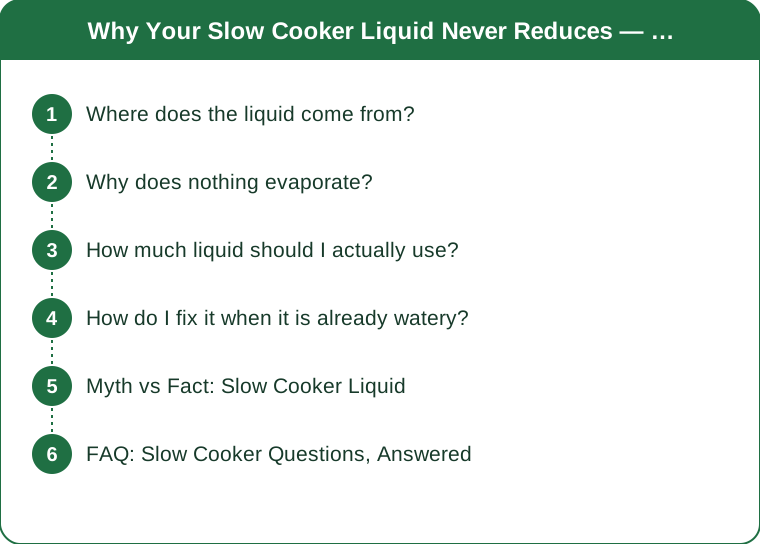
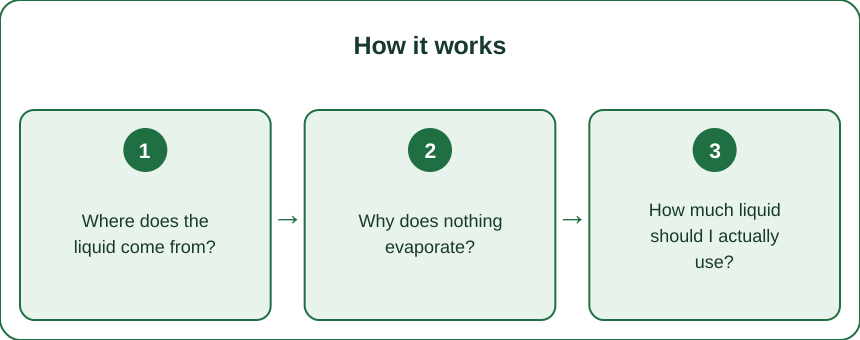
Where does the liquid come from?
Two sources, and one of them is invisible.
The liquid you add, which is the part you control.
The liquid the ingredients release, which is larger than most people expect. Meat is roughly 60 to 75% water, and vegetables can be over 90%. As they heat, cells rupture and that water goes into the pot.
A slow cooker full of onions, mushrooms, tomatoes and meat can generate a substantial volume of liquid without a drop added — which is exactly why a recipe that adds a cup of stock finishes as soup.
Mushrooms and courgette are the worst offenders, followed by onions and any tinned tomato. Root vegetables release far less.
So the arithmetic is: added liquid plus released liquid, minus evaporation — and evaporation is the term that is missing.
Why does nothing evaporate?
Because the lid returns it all.
In an open pot, steam leaves and the liquid concentrates. That is reduction, and it is where sauce thickness and flavour concentration come from.
A slow cooker lid is a condensing surface. Steam rises, hits the cooler lid, condenses into droplets, and runs straight back down. The seal is good enough that very little escapes.
The result is a closed system. Liquid volume can only go up, from what the ingredients release.
This is also why slow cookers are so good at what they are good at — nothing dries out, nothing burns, tough cuts break down beautifully in a moist environment. The same property that makes them reliable makes them unable to reduce.
Lifting the lid to let steam out is a poor solution. Each lift loses significant heat and adds substantially to the cooking time, for a small amount of evaporation.
How much liquid should I actually use?
Far less than a conventional recipe, and it feels wrong the first time.
Cut added liquid to one third or one half of what an oven or stovetop recipe specifies. For a stew with plenty of vegetables, you often need almost none — the ingredients supply it.
The liquid should come partway up the ingredients, not cover them. Roughly halfway is a good target for a meat and vegetable braise. Everything above the liquid line still cooks perfectly in the steam.
Exceptions where you do need full liquid: anything with dried grains, pulses or pasta, which absorb water; and soups, where liquid is the point.
When adapting a recipe, the reliable method is to reduce added liquid by half, cook, and see. You can always add liquid at the end; you cannot easily remove it.
How do I fix it when it is already watery?
Four options, best first.
Cook uncovered on high for 30 to 45 minutes at the end. With the lid off, evaporation finally happens. This is the cleanest fix because it concentrates flavour rather than diluting it, and most slow cookers reach a decent simmer on high.
Remove the solids and reduce the liquid in a pan. Faster and more controllable — a wide pan on a high heat reduces in ten minutes. Then pour it back over. This gives the best result if you have the extra pan and five minutes.
Thicken with a starch slurry. A tablespoon of cornflour mixed with cold water, stirred in, then 20 to 30 minutes on high to cook out. It thickens without concentrating flavour, so taste and adjust seasoning afterward — a thickened but dilute sauce still tastes dilute.
Add something absorbent. A handful of red lentils, a grated potato, or instant mash stirred through will take up liquid and thicken. Useful in a pinch, and it changes the character of the dish.
Whichever you use, season at the end. Salt does not evaporate, so a dish that was correctly seasoned when watery becomes over-salted once reduced.
Myth vs Fact: Slow Cooker Liquid
Myth: you need to cover the ingredients in liquid. Fact: this is the single most common slow cooker mistake, imported from stovetop braising. Halfway up is plenty, because the sealed environment cooks everything above the line in steam.
Myth: the recipe is wrong if it is watery. Fact: most published recipes are conversions from conventional methods, and the liquid quantity is frequently unadjusted. Assume you need to cut it.
Myth: propping the lid open reduces the liquid. Fact: it drops the internal temperature substantially, which extends cooking time and risks holding food in the temperature range where bacteria multiply. Uncovered on high at the end is the safe version.
Myth: high and low differ in temperature. Fact: on most models they reach a similar final temperature — low simply takes longer to get there. That is why low is better for tough cuts and why swapping does not solve a liquid problem.
Myth: browning first is optional. Fact: it is optional for safety and essential for flavour. A slow cooker cannot brown anything, so all the Maillard flavour in the finished dish has to be created before it goes in — and browning also drives off some surface moisture.
FAQ: Slow Cooker Questions, Answered
Can I just leave the lid off for the whole cook?
No. The lid maintains the cooking temperature, and without it many slow cookers will not reach or hold a safe temperature — you can spend hours in the range where bacteria multiply. Uncovered is for the final 30 to 45 minutes on high, when the food is already hot and cooked.
Does opening the lid to stir really matter?
More than you would expect. Each lift can add 20 to 30 minutes to the total cook because of the heat lost, and slow cookers recover slowly. Food in a slow cooker does not need stirring — it is a moist, even environment, and stirring is a habit from stovetop cooking.
Why is my chicken dry when everything else is swimming?
Because lean chicken breast overcooks long before the liquid problem resolves. Use thighs, or add breast in the last hour. Dryness in a wet environment sounds contradictory, but it is muscle fibres contracting and squeezing out their own moisture — into the pot, which is part of where all that liquid came from.
TL;DR:
- A slow cooker is a closed system. Steam condenses on the lid and returns, so liquid volume can only go up.
- Ingredients release a lot of water — meat is 60 to 75% water and vegetables can be over 90%. That alone is often enough.
- Cut added liquid to one third or one half of a conventional recipe, with liquid coming only halfway up the ingredients.
- To fix a watery result, cook uncovered on high for 30 to 45 minutes, or reduce the liquid separately in a wide pan — then season, because salt did not evaporate either.
Brown everything before it goes in. The appliance cannot do it, and that is where most of the flavour in a good slow-cooked dish actually comes from.
Keep Reading
This article is for general informational purposes only and is not medical advice. Always consult a qualified health professional for guidance specific to you.