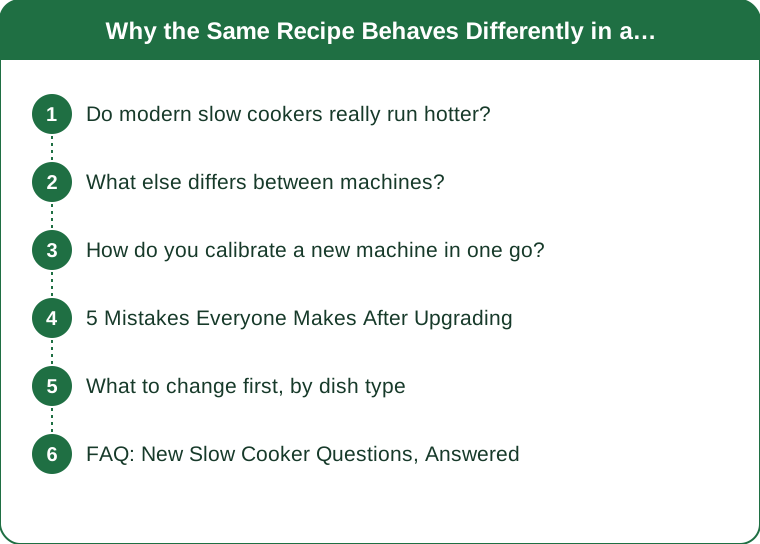
Why the Same Recipe Behaves Differently in a New Slow Cooker
Quick Answer: Modern slow cookers generally run hotter and reach temperature faster than older ones, largely because of food-safety guidance that pushed manufacturers to get contents out of the bacterial danger zone more quickly. Add differences in crock material, shape, wattage and lid seal, and the same recipe in a new machine can finish one to two hours earlier and with noticeably more evaporation. Recalibrate with a single test batch rather than assuming the recipe is wrong.
Your old recipes are not broken.
They were tuned to a machine you no longer own.
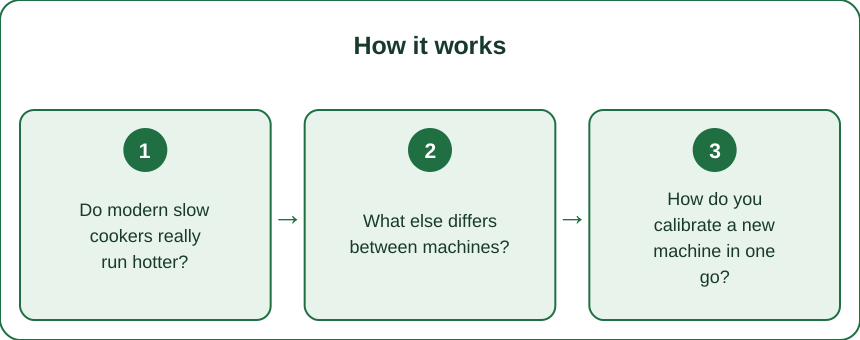
Do modern slow cookers really run hotter?
Generally yes, and the reason is regulatory rather than culinary.
Food safety guidance is concerned with the temperature range in which bacteria multiply most readily — broadly between about 5°C and 60°C. The longer food sits in that band, the more growth occurs. A slow cooker that takes four hours to bring a full crock of cold ingredients up past that range is spending a long time somewhere nobody wants it to spend time.
Manufacturers responded by increasing wattage and adjusting the heating profile, so contemporary machines climb out of that range faster and often hold a higher steady temperature.
The practical consequences:
Recipes finish earlier. A dish written for a machine from the nineties frequently overcooks by an hour or more in a new one on the same setting.
Low is hotter than it used to be. Many people’s mental model of “low” was formed on a gentler appliance.
Vegetables and lean proteins suffer most. They have the narrowest window between done and ruined, so they show the difference first.
This is also why so many older family recipes come with times that seem absurdly long. They were not wrong. The appliance changed underneath them.
What else differs between machines?
Four things, and they matter roughly in this order.
Crock material and thickness. Traditional stoneware is thick and thermally slow — it takes a long time to heat and holds heat well after. Thinner ceramic and metal inserts respond faster and cool faster. A machine with a metal insert behaves noticeably differently from a heavy stoneware one even at an identical set temperature.
Shape. Oval and round crocks of the same stated capacity have different surface-area-to-volume ratios, which changes evaporation and how food layers. Tall narrow crocks concentrate; wide shallow ones reduce and brown at the edges.
Lid seal. A lid that sits loosely lets steam escape steadily, which concentrates sauces and lowers the effective temperature slightly. A well-sealed or gasketed lid keeps almost everything in, which is why the same recipe can come out watery in one machine and perfect in another. This alone explains a large share of the “my sauce is thin” complaints after an upgrade.
Wattage relative to capacity. A 6.5-litre machine at 320 watts and a 3.5-litre machine at 250 watts are not delivering the same intensity per unit of food. The bigger machine run half-full is a different cooking environment again.
None of these appear in recipes, because recipes are written for an imaginary standard slow cooker that does not exist.
How do you calibrate a new machine in one go?
One test, about four hours, and it settles everything.
The water test. Fill the crock two-thirds with room-temperature water. Cover, set to low, and leave for four hours without lifting the lid. Then take the temperature with a probe thermometer.
What the number means:
Around 85 to 93°C — a typical, well-behaved low setting. Your standard recipes should work with a modest reduction in time.
Above about 95°C, or actively simmering — your machine runs hot. Expect to cut times by roughly a quarter and to use low where a recipe says low, never high.
Below about 80°C — a gentle machine, closer to the older generation. Long recipe times will suit it, and you should be careful with anything that needs to reach a safe internal temperature reliably.
Repeat on high if you use that setting. High on most modern machines will hold a gentle simmer.
Then adjust your recipes once, in writing. A note on the recipe card — “new cooker: low, 5.5h not 7” — is worth more than remembering. It takes one afternoon and it fixes every recipe you own rather than one at a time.
5 Mistakes Everyone Makes After Upgrading
1. Blaming the recipe. The first three failures after a new machine get attributed to the recipe, the meat or the brand of stock. It is almost always the appliance, and the giveaway is that everything is failing in the same direction — usually drier and more done.
2. Keeping the same liquid quantity. Slow cookers with better seals lose far less liquid. A recipe that was written to end up right after four hours of evaporation ends up soupy in a tight-lidded machine. Reduce added liquid by roughly a third and adjust from there.
3. Using a machine that is too big for the recipe. Slow cookers are designed to run between about half and three-quarters full. A half-recipe in a large crock cooks much faster, sits in a thinner layer, and dries out at the edges. This is the most common cause of disappointing results after upgrading to a bigger model.
4. Assuming low is the safe option. Low on a hot modern machine can be brisker than high was on an old gentle one. Low reduces intensity relative to that same machine’s high setting — it says nothing about the absolute temperature.
5. Adjusting several things at once. This is the one that makes the problem last for months — change the time, the liquid and the setting together and you learn nothing from the result, and you end up with a machine you never really understood and a set of recipes you no longer trust.
What to change first, by dish type
Different foods respond differently to a hotter machine, so tackle them in this order.
Lean proteins first. Chicken breast, pork loin and any lean cut have the narrowest tolerance. Reduce by 1 to 2 hours immediately and check early. Stringy, dry chicken is the classic new-machine symptom.
Then vegetables. Root vegetables in large chunks tolerate it; anything softer needs to go in later than the recipe says. Adding delicate vegetables in the last hour rather than at the start is the general fix and it becomes more important on a hot machine.
Then liquids and sauces. Reduce added liquid by around a third with a well-sealed lid. If a sauce is still thin at the end, the fix is the last 30 minutes with the lid off or slightly ajar, not more thickener.
Tough cuts last. Beef shin, lamb shoulder, brisket and similar are the most forgiving things you can cook, and they mask the differences between machines. Which is exactly why they are a bad way to learn a new cooker — everything works, so you learn nothing.
One seasonal note as the weather turns: a cold kitchen slows a slow cooker measurably, particularly with a thick stoneware crock and cold ingredients straight from the fridge. Autumn and winter batches genuinely do take longer than the same recipe did in July, which can partially disguise a hot machine for a few months before spring reveals it again.
Standard safety points still apply: do not use a slow cooker to reheat, do not put frozen meat in without accounting for the extra time in the danger zone, and use a thermometer to confirm safe internal temperatures for poultry and pork.
FAQ: New Slow Cooker Questions, Answered
How much should I cut cooking times by?
Start with 25% less on a machine that tested hot, and check an hour before the reduced time on your first attempt. After two or three dishes you will have a reliable feel for the offset.
Is a digital slow cooker more accurate than a dial one?
More repeatable rather than more accurate. Digital models hold their programme reliably and often switch to warm automatically, which is genuinely useful. The actual temperature still varies between brands, so the water test is worth doing either way.
Why does my new machine leave a ring of overcooked food at the edge?
Usually the crock is underfilled, or the heating elements wrap the sides rather than sitting only underneath. Fill to at least half, stir if the recipe allows, and consider a smaller machine for smaller batches.
Does the keep-warm setting count as cooking?
It continues to cook slowly, yes — particularly on machines where warm runs above 70°C. Food left on warm for three hours after a finished cook is meaningfully more cooked than it was at the end of the programme.
Should I keep my old slow cooker?
If you have space, a smaller gentle machine is genuinely useful alongside a big modern one, particularly for small batches and for anything delicate. Two sizes is more practical than one large one for most households.
TL;DR:
- Modern slow cookers run hotter and heat faster, driven by food-safety guidance rather than cooking preference
- Crock material, shape, lid seal and wattage-per-litre all change the result independently of the setting
- Do the four-hour water test once and write the offset on your recipe cards
- Reduce added liquid by about a third with a well-sealed lid, and run between half and three-quarters full
- Lean proteins reveal the difference first; tough cuts hide it, so they are a poor way to learn a new machine
Before your next batch, fill the crock with water, set it to low for four hours and take its temperature. One afternoon of testing fixes every recipe you own instead of one dinner at a time.
Keep Reading
This article is for general informational purposes only and is not medical advice. Always consult a qualified health professional for guidance specific to you.