Why Your Slow Cooker Vegetables Always Turn to Mush (and the Timing Fix)
Quick Answer: Vegetables turn mushy in a slow cooker because they’re usually added at the start alongside the meat, but they cook through far faster than tough cuts of meat need. Adding root vegetables partway through, and delicate vegetables in the last hour, fixes the texture.
You followed the recipe, dumped everything in together at the start, and 8 hours later the meat was perfect but the vegetables had disintegrated into the sauce. That’s a timing issue, not a slow cooker limitation.
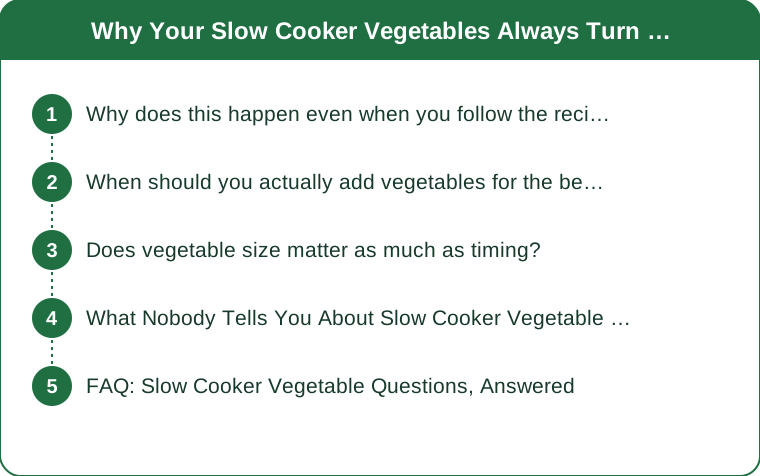
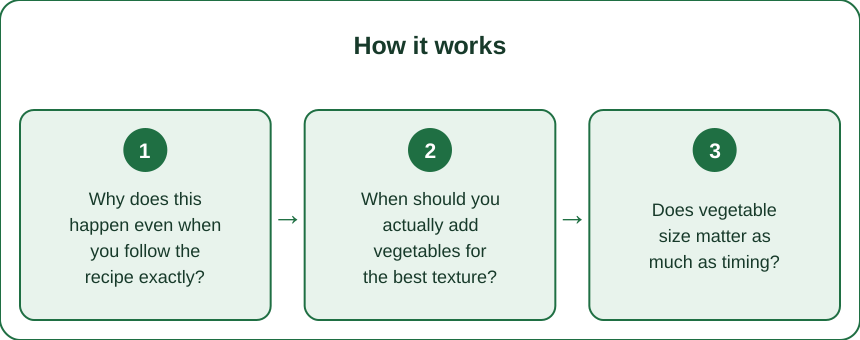
Why does this happen even when you follow the recipe exactly?
Many slow cooker recipes are written for convenience (dump everything in at once), not optimal texture — they prioritize a single “add and walk away” step over ideal doneness for every ingredient. Tough cuts of meat need 6-8 hours to break down collagen and become tender; most vegetables are fully cooked in 2-4 hours at the same temperature.
By hour 8, vegetables that were done at hour 3 have been cooking for 5 extra hours in liquid, well past done into mush territory.
When should you actually add vegetables for the best texture?
Hardy root vegetables (potatoes, carrots, parsnips): add in the first half, around hour 3-4 of an 8-hour cook — they need real time but not the full duration. Firm vegetables (celery, bell peppers): add around the 2-hour mark remaining. Delicate vegetables (zucchini, peas, leafy greens, fresh herbs): add in the final 30-60 minutes — they cook fast and turn to mush almost immediately at full duration.
If your slow cooker has a keep-warm function, use it as your buffer — add delicate vegetables right before you switch to warm, not during active high heat.
Does vegetable size matter as much as timing?
Yes, almost as much. Large, uniform chunks (1.5-2 inch pieces for potatoes and carrots) hold their shape far longer than small diced pieces, which break down faster and are more prone to mush regardless of when they’re added. Cutting vegetables larger than you think you need to is one of the simplest fixes for slow cooker texture problems.
What Nobody Tells You About Slow Cooker Vegetable Prep
Vegetables placed at the bottom of the slow cooker, under the meat, cook faster than the same vegetable placed on top — they’re closer to the heat source and sitting in more concentrated liquid and juices. If you want vegetables to hold up better, layer them toward the top or sides, not directly on the bottom under a heavy roast.
This single placement change can add an extra hour of “hold together” time without changing anything else about your recipe.
FAQ: Slow Cooker Vegetable Questions, Answered
Can you add frozen vegetables directly to a slow cooker?
Yes, but add them later in the cook (last 1-1.5 hours) since they release extra water as they thaw, which can water down your dish if added too early.
Do potatoes need to be peeled to hold up better?
Not necessarily — skin-on potatoes actually hold structure slightly better than peeled, since the skin adds a bit of physical integrity during long cooking.
Why do my vegetables taste bland even when they hold their shape?
Vegetables added late don’t have as much time to absorb the seasoned cooking liquid — a quick toss in a spoonful of the broth right before serving fixes this without needing to cook them longer.
TL;DR:
- Vegetables cook much faster than tough meat cuts — add them partway through, not at the start
- Root vegetables: hour 3-4; firm vegetables: last 2 hours; delicate vegetables: last 30-60 minutes
- Cut vegetables into larger chunks (1.5-2 inches) to help them hold shape
- Placement matters too — vegetables under the meat cook faster than those toward the top
Same recipe, same slow cooker — just staggering when things go in fixes the mush problem completely.
Keep Reading
This article is for general informational purposes only and is not medical advice. Always consult a qualified health professional for guidance specific to you.