Why a Half-Full Slow Cooker Cooks Differently Than a Full One
Quick Answer: Slow cookers heat through the sides of the crock, not the base, and they’re calibrated to reach a safe simmer at roughly two-thirds full. Below half, the same heat output hits a smaller mass of food and scorches the edges. Above three-quarters, it can’t get the center hot enough fast enough. The fill line is a cooking variable, not a storage suggestion.
You halved a recipe that always works, and it came out with a burnt ring around the edge and a watery middle. The recipe is fine. The fill level is what changed.
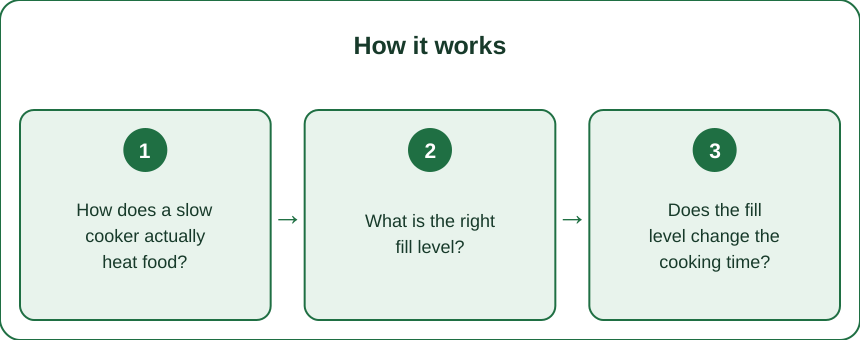
How does a slow cooker actually heat food?
Through the walls, which is why the amount in the crock matters so much more than in a pot on a stove.
The heating element wraps the sides of the housing, not the bottom. Heat transfers into the ceramic crock around its circumference and then inward through the food. There’s no burner underneath doing the work.
This means the food itself is part of the heating system. A full crock has a large thermal mass that absorbs and distributes heat evenly. A quarter-full crock has a thin layer of food pressed against very hot walls with nothing in the middle to absorb into.
Manufacturers calibrate to the sweet spot. Most slow cookers are designed to reach 209°F or so — just under a simmer — when filled between one-half and three-quarters. That’s the range where the wattage and the food volume balance out.
What that means for the two failure modes
Underfilled, the walls transfer more heat than the food can absorb, so the outer inch overcooks and dries into a dark ring while liquid evaporates faster than the recipe expects.
Overfilled, the center of the mass takes hours to climb through the range where bacteria multiply, which is a food-safety concern rather than just a texture one.
What is the right fill level?
Between one-half and three-quarters of the crock’s stated capacity, and closer to two-thirds if you want the recipe to behave exactly as written.
Measure by volume, not by looks. A 6-quart crock two-thirds full holds about 4 quarts. Most people eyeball this and land low, because a crock looks fuller than it is once you’re looking down into it.
Count the liquid separately. Slow cookers lose very little moisture, so recipes are written with less liquid than a stovetop version. But if you’re underfilled, evaporation goes up and that already-lean liquid disappears. Halving a recipe is where this bites hardest — people halve the solids and halve the liquid, and the ratio that worked at full scale collapses.
If you must cook a small batch, use a smaller appliance or add an inert bulk — an extra cup of stock, a quartered onion, a couple of whole carrots — to get volume back up. You can pull the filler out at the end.
If you’re near the top, cut dense proteins into smaller pieces so the center of the mass heats faster, and don’t stack cold ingredients straight from the fridge in a full crock.
Does the fill level change the cooking time?
Yes, and in the direction most people guess wrong.
An underfilled crock finishes early, sometimes by an hour or more on a 6-hour recipe, because there’s less mass to bring up to temperature and the walls are running hot relative to that mass. If you set it and leave, you come home to something overdone.
An overfilled crock runs late — often 1 to 2 hours late on low — because the center takes far longer to reach temperature. This is the version that produces “I cooked it for eight hours and the potatoes are still hard.”
Neither one is fixed by changing the setting. Bumping an overfilled cooker to high heats the outside faster without fixing the transfer rate into the center, so you get scorched edges and hard middles simultaneously.
A practical adjustment
For a half-batch, reduce time by roughly 25% and check early. For a near-full crock, add an hour and give it a stir at the midpoint if you’re home — one stir is worth more here than in almost any other slow-cooker situation, because it physically moves the cold center to the hot wall.
Late-summer note
This is the season people start pulling the slow cooker back out for the first soups and chilis after months of not using it. The first batch of the season is disproportionately likely to be a half-batch — a test run — which is exactly the scenario that produces the burnt ring and the conclusion that the appliance has gone bad.
5 Mistakes That Trace Back to Fill Level
1. Halving a recipe without adjusting liquid ratio. Half the solids and half the liquid in a full-size crock means more evaporation across less food. Keep liquid closer to two-thirds of the original rather than half.
2. Using a 6-quart cooker for a two-person dinner. The single most common cause of scorched edges. A 3-quart cooker is a genuinely worthwhile second appliance if you cook small most weeks.
3. Filling to the rim for a crowd. Above three-quarters, the center may sit in the 40–140°F range too long. This is the one failure mode that’s a safety issue, not just a texture one.
4. Blaming the appliance after one bad batch. “My slow cooker runs hot now” is usually “I cooked less in it than I used to.” Check the fill before replacing anything.
5. Assuming frozen ingredients just add time. In an already-full crock, a frozen block extends the time the center spends warming up, which stacks two problems on top of each other.
FAQ: Slow Cooker Fill Questions, Answered
What if my recipe doesn’t fill the crock even at full scale?
Add bulk vegetables or extra stock to reach the half line, or use a smaller cooker. Don’t just accept a quarter-full crock.
Does the shape of the crock matter?
Somewhat — oval crocks have more wall surface per volume than round ones, so they’re slightly less forgiving when underfilled.
Can I use a foil sling or a smaller insert inside a big cooker?
An oven-safe dish set inside with water around it works well for small batches. The water becomes the thermal mass.
Is the burnt ring on the side dangerous?
No, just unpleasant. Scrape it off and correct the fill next time.
Does high vs low change the ideal fill?
No. Both settings assume the same half-to-three-quarters range; high just gets there faster.
TL;DR:
- Slow cookers heat through the side walls, so the amount of food is part of the heating system
- Aim for half to three-quarters full — two-thirds is the calibration target
- Underfilled scorches the edges and finishes early; overfilled runs late and raises a real safety concern
- Halving a recipe requires keeping more liquid than half, not less
- One stir at the midpoint helps a near-full crock more than changing the setting does
Before you decide your slow cooker has stopped working, check how much you put in it. That number is doing more than you think.
Keep Reading
This article is for general informational purposes only and is not medical advice. Always consult a qualified health professional for guidance specific to you.