Why Doubling a Slow Cooker Recipe Does Not Work the Way You Expect
Quick Answer: Doubling a slow cooker recipe adds mass without adding heating power, so the pot takes far longer to reach temperature and the liquid concentration goes wrong. Add roughly 25-50% to the cook time rather than doubling it, cut the added liquid to about half what the doubled recipe calls for, and never fill past three-quarters. If the doubled volume exceeds your cooker’s capacity, two batches genuinely beats one crowded one.
You had eight people coming instead of four, so you doubled everything and added two hours. It came out watery, and the potatoes were somehow both mushy and undercooked.
The arithmetic that works for an oven does not work here, and the reason is worth understanding.
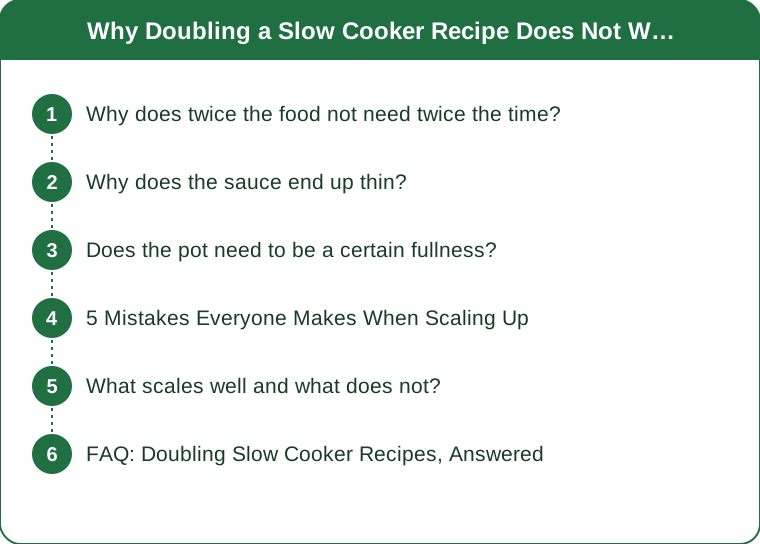
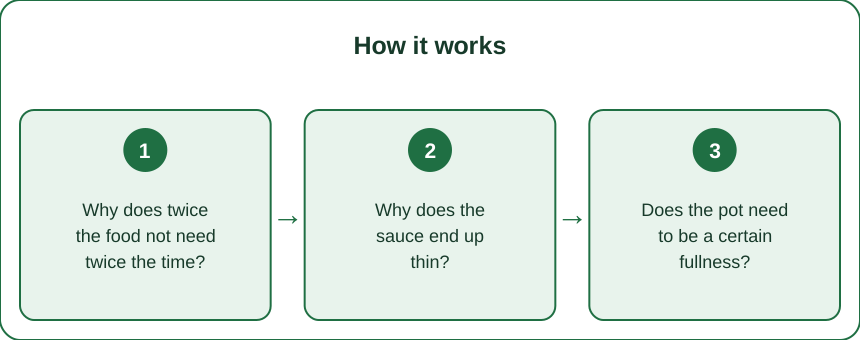
Why does twice the food not need twice the time?
Because a slow cooker heats from the walls at a fixed rate, and cooking time is dominated by how long it takes the whole mass to reach temperature — not by how much food there is once it gets there.
A slow cooker’s heating element delivers a roughly constant amount of power regardless of what is inside. Double the mass and that same power has to raise twice as much material to temperature. The come-up phase — the hours before the pot reaches a stable simmer — stretches considerably.
But once everything is at temperature, the actual cooking chemistry proceeds at the same rate whether there is one kilo or three in there. Collagen breaks down on its own schedule.
So the extra time you need is the extra come-up time, not a doubling of the whole cook. In practice that lands at 25-50% more, depending on how cold the ingredients went in and how full the pot is.
Doubling the time instead usually overshoots badly. Six hours becomes twelve, the meat passes from tender through to stringy, and the vegetables disintegrate.
Why does the sauce end up thin?
This is the failure that surprises people most, and it comes from a geometry problem.
Slow cookers lose very little moisture — the lid seals, condensation runs back in, and almost nothing evaporates. Recipes are written knowing this, which is why they call for much less liquid than a stovetop equivalent.
When you double, you double the liquid too. But the ingredients themselves also release moisture as they cook, and that release scales with the amount of food. So you get double the added liquid plus double the released liquid, in a pot with proportionally less surface area for the tiny amount of evaporation that does occur.
The practical rule: when doubling, add about half the extra liquid the recipe calls for. If a recipe uses 200ml for one batch, use around 300ml for a double, not 400ml.
If it still comes out thin, the recovery is straightforward — remove the lid for the final 30-45 minutes on high, or lift out the solids and reduce the liquid in a pan while everything else rests.
Does the pot need to be a certain fullness?
Yes, and this is where most doubling attempts actually fail.
Slow cookers are designed to operate between roughly half full and three-quarters full. Below half, the contents heat too fast and scorch at the edges. Above three-quarters, several things go wrong at once:
- The centre takes dramatically longer to reach temperature, which in the danger zone between 4°C and 60°C is a food safety issue, not just a quality one
- Liquid can boil up and escape past the lid seal
- There is no room for the circulation that produces even cooking
If your doubled recipe fills the pot past three-quarters, the doubling is not viable in that cooker. Two sequential batches will produce a better result than one overfilled one, and a larger cooker is the real answer if you batch cook often.
A useful check before you commit: put the doubled raw ingredients in the pot dry, look at the level, and then decide. It takes thirty seconds and saves an eight-hour disappointment.
5 Mistakes Everyone Makes When Scaling Up
1. Doubling the seasoning. Salt, and particularly dried herbs and chilli, do not scale linearly in a sealed environment where nothing evaporates. Start at about 1.5x, taste in the final hour, and adjust then. Doubled chilli in a slow cooker is a genuinely unpleasant surprise.
2. Adding everything cold straight from the fridge. Doubled mass plus fridge-cold ingredients can add two hours to the come-up alone. Letting meat sit out for 20-30 minutes and using warm rather than cold stock makes a real difference to the timeline.
3. Cutting vegetables the same size as before. In a fuller pot, larger pieces are the right call — they survive the longer total cook. Doubling a recipe and keeping small dice is how you end up with vegetable purée and meat that is not quite done.
4. Stacking instead of layering. In a crowded pot, position matters far more. Dense root vegetables go at the bottom where the heat is; meat sits above them; anything delicate goes in for the last hour. Just tipping everything in produces exactly the mushy-and-underdone combination people complain about.
5. Lifting the lid to check. Always costly, and much more so with a doubled batch. Each lid lift releases the accumulated heat that took a long time to build, and in a full pot the recovery takes 20-30 minutes. If you must check, do it once, late.
And one worth adding: doubling a recipe that relies on the browning step and skipping the browning to save time. Doubled volume dilutes flavour more than people expect, and the browning is where a large batch gets its depth. It is the least skippable step precisely when you are scaling up.
What scales well and what does not?
Some dishes double beautifully and some should never be attempted.
Scales well: tough cuts in liquid — beef shin, shoulder, oxtail, shin of lamb. Dried pulses and beans. Stocks and broths. Chilli, ragù, and anything where a longer, more forgiving window is fine.
Scales badly: chicken breast, which is already at the edge of its tolerance in a single batch and turns to fibre with the extra come-up time. Fish, for the same reason. Dairy-based sauces, which separate over longer cooks. Anything with rice or pasta cooked in the pot, since the starch-to-liquid ratio is unforgiving and the extended timeline makes it worse.
Needs adjustment: dishes with potatoes. They hold up better than expected but need to be cut larger and placed at the bottom.
The best approach for anything on the ‘scales badly’ list is to cook the base doubled and add the delicate component to each portion separately — poach the chicken separately and stir it through, cook the rice on the side, add the cream at the end off the heat.
And on food safety: with any large batch, cooling matters as much as cooking. Divide leftovers into shallow containers rather than refrigerating the whole pot, which can take many hours to cool through and sits in the danger zone the entire time.
FAQ: Doubling Slow Cooker Recipes, Answered
Can I double a recipe on low, or should I switch to high?
Stay on low for anything where texture matters — high does not fix the come-up problem, it just makes the outside cook harder while the centre catches up. The exception is starting on high for the first hour to get through the come-up phase faster, then switching to low for the remainder. That is genuinely useful with a doubled batch.
How do I know it is actually done in the middle?
Use a thermometer in the centre of the largest piece, not at the edge. For pulled pork or beef you want somewhere around 90-96°C for the collagen to have broken down; for poultry, at least 74°C throughout. In a full pot the edge-to-centre difference can be substantial, and eyeballing it is unreliable.
Is it better to use two slow cookers?
If you have them, yes — it is the cleanest solution. Two pots each at their correct fill level cook on the original timing with no adjustments at all, which removes every problem described above. It is the reason people who batch cook regularly tend to own a second one.
TL;DR:
- Add 25-50% to the cook time, not 100% — the extra time is come-up time, not cooking time.
- Add roughly half the extra liquid, because a sealed slow cooker loses almost nothing to evaporation.
- Never fill past three-quarters; if the double does not fit, two batches genuinely beats one crowded pot.
- Scale seasoning at about 1.5x and adjust in the final hour; cut vegetables larger; layer dense items at the bottom.
- Tough cuts, pulses and stocks double well; chicken breast, fish, dairy sauces and in-pot rice do not.
The thing that makes slow cookers so forgiving in normal use — the sealed, low, slow environment — is exactly what makes them unforgiving when you scale up. Once you stop treating it as an oven with a longer clock and start treating it as a pot with a fixed heating budget, the adjustments are simple and the results hold.
Keep Reading
This article is for general informational purposes only and is not medical advice. Always consult a qualified health professional for guidance specific to you.