Why Slow Cooker Chicken Breast Turns Stringy While Thighs Stay Tender
Quick Answer: Chicken thighs contain roughly three times the connective tissue and significantly more intramuscular fat than breast. That collagen melts into gelatin over long cooking and keeps the meat moist, while breast has almost none to convert — so once its muscle fibers contract and expel water past about 165°F, there’s nothing left to compensate. Breast needs less time, not more.
Everyone tells you slow cooking makes meat tender. For thighs it does. For breast, past a certain point, more time makes it strictly worse, and no amount of extra liquid in the pot changes it.
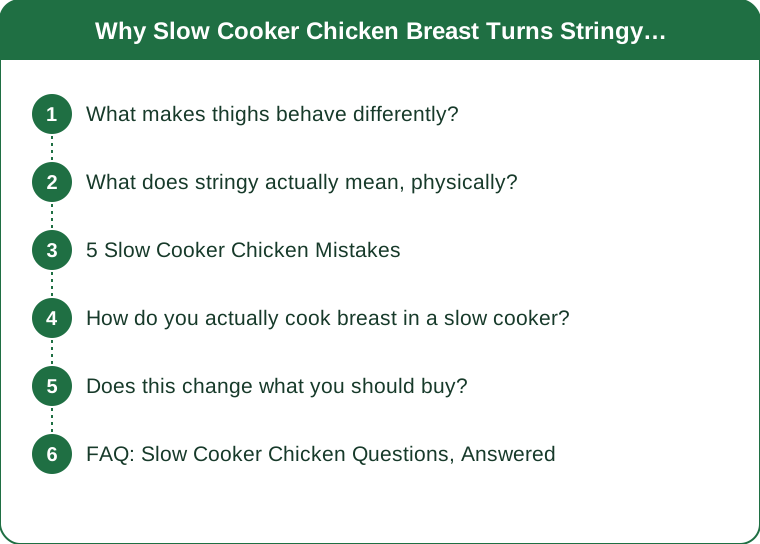
What makes thighs behave differently?
Two things, and they compound.
Connective tissue. Thighs are working muscle from a bird that stands all day, so they’re threaded with collagen. Above roughly 160°F, and much faster above 180°F, collagen converts to gelatin. Gelatin holds water, coats the muscle fibers, and gives braised meat its silky texture.
Fat. Thigh meat carries meaningfully more intramuscular fat, which renders slowly and lubricates the fibers as they contract.
Breast has almost neither. It’s a low-use muscle, lean, and structurally simple — long fibers with minimal connective tissue between them.
So when both are held at 190°F for six hours, the thigh is actively improving while the breast has nothing to gain and everything to lose.
What does stringy actually mean, physically?
It means the muscle fibers have contracted, expelled their water, and separated from each other with nothing binding them.
Muscle protein denatures in stages. Around 140 to 150°F the fibers begin contracting lengthwise, squeezing out moisture. By 165°F most of that water loss has occurred. Continued heat keeps tightening the fibers and driving out what’s left.
In a thigh, gelatin fills the space between those contracted fibers, so the meat reads as moist even though the muscle itself has lost water. In a breast, the space just stays empty and the fibers pull apart individually. That’s the stringiness — you’re eating separated fiber bundles with no matrix between them.
This is also why sitting the breast in liquid doesn’t rescue it. Meat doesn’t reabsorb water it has expelled. The liquid is on the outside of a structure that has already closed.
5 Slow Cooker Chicken Mistakes
1. Cooking breast for the same duration as thigh. Breast needs 2 to 3 hours on low; thigh wants 6 to 8. They’re not interchangeable in a recipe.
2. Adding too much liquid. A slow cooker loses almost no moisture, and the meat releases its own. Excess liquid dilutes flavor and does nothing for texture — half a cup is plenty for a full pot.
3. Using the high setting for breast. High reaches around 300°F at the vessel wall and drives the fiber contraction faster. If you must cook breast in a slow cooker, low only.
4. Cooking it whole rather than in one layer. Uneven thickness means the thin end is at 190°F while the thick end is still climbing. Pound to even thickness or cut into uniform pieces.
5. Judging by time rather than temperature. Slow cookers vary enormously between models and by how full they are. 165°F on an instant-read is the only reliable endpoint for breast.

How do you actually cook breast in a slow cooker?
You can, but you have to treat it as a different recipe.
Add it late. If you’re making a stew or chili that runs six hours, put the breast in for the final 60 to 90 minutes. It’ll reach temperature and stop there.
Cook it in a sauce with body. A sauce containing fat, dairy, or gelatin — coconut milk, a tomato base with olive oil, stock made from bones — coats the fibers and does externally what thigh meat does internally. This genuinely helps.
Or embrace shredding. Breast that’s going to be shredded and tossed back into liquid is far more forgiving, because you’re deliberately separating fibers and re-coating them. Cook to 165°F, shred, and return it to the pot off heat with a few tablespoons of the cooking liquid.
Never hold it on warm. The warm setting sits around 165 to 175°F, which is above the damage threshold. Two hours on warm undoes a perfectly cooked breast.
Does this change what you should buy?
For anything cooked long — stews, braises, shredded fillings, curries — buy thighs. They’re cheaper, more forgiving, and structurally correct for the method. The window between done and overdone is measured in hours rather than minutes.
For breast, the honest answer is that the slow cooker is the wrong tool. A 20-minute poach, a sear-and-rest, or a 165°F sous vide all produce better breast than any slow cooker program.
If you’re cooking for a household that objects to dark meat, the workable compromise is thighs for the base and breast added at the end — you get the gelatin-rich braising liquid from one and the texture preference from the other.
And on the food safety side: 165°F is the target for all poultry, and it’s an instantaneous kill temperature. Longer cooking adds safety margin you don’t need and texture cost you can’t reverse.
FAQ: Slow Cooker Chicken Questions, Answered
Can I fix chicken that’s already stringy?
Partly. Shred it finely and stir it into a fatty or gelatin-rich sauce off the heat — the coating masks the separated fibers. You can’t restore the original texture, but you can make it pleasant.
Why does restaurant shredded chicken never taste dry?
Usually because it’s dark meat, and often because it’s been shredded into a sauce with rendered fat and reduced stock. Both mechanisms do the same job: put something between the fibers.
Is bone-in better in a slow cooker?
Yes, noticeably. Bones and skin contribute collagen to the liquid, which improves the sauce and gives even breast meat something to be coated in. Bone-in split breast holds up considerably better than boneless.
TL;DR:
- Thighs have collagen and fat that convert to gelatin; breast has neither and just dries out.
- Fibers expel water past 165°F and never reabsorb it, so more liquid in the pot doesn’t help.
- Add breast in the final 60 to 90 minutes, cook to temperature, and never hold it on warm.
- For long cooking, thighs are cheaper, better, and vastly more forgiving.
The slow cooker’s reputation for making everything tender comes from what it does to tough cuts, and breast simply isn’t one. Once you stop asking it to solve a problem breast doesn’t have, the pot gets a lot more reliable — and the thighs, as always, take care of themselves.
Keep Reading
This article is for general informational purposes only and is not medical advice. Always consult a qualified health professional for guidance specific to you.