Why the Delayed Start Timer Is the Riskiest Slow Cooker Feature
Quick Answer: A delayed start leaves raw food sitting between about 5°C and 60°C - the range where bacteria multiply fastest - for however long the delay lasts. Food safety guidance generally limits that window to two hours, and a six-hour delay blows straight through it. The cooking that follows kills the bacteria but does not reliably remove the toxins some of them have already produced. Use the keep-warm-after-cooking function instead; skip the delay-before-cooking one.
Here is the actual mechanism, and what to do instead so dinner is still ready when you get home.
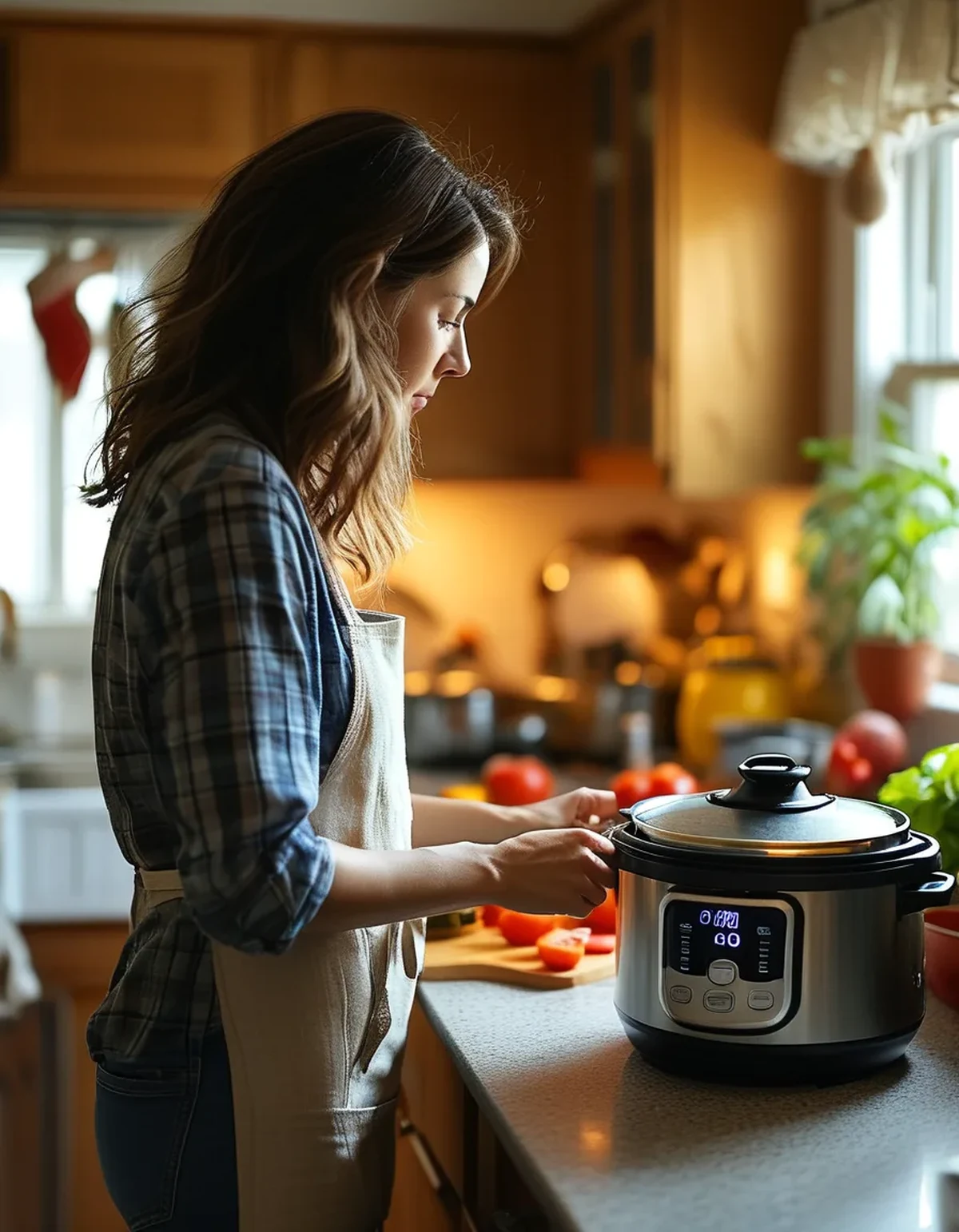
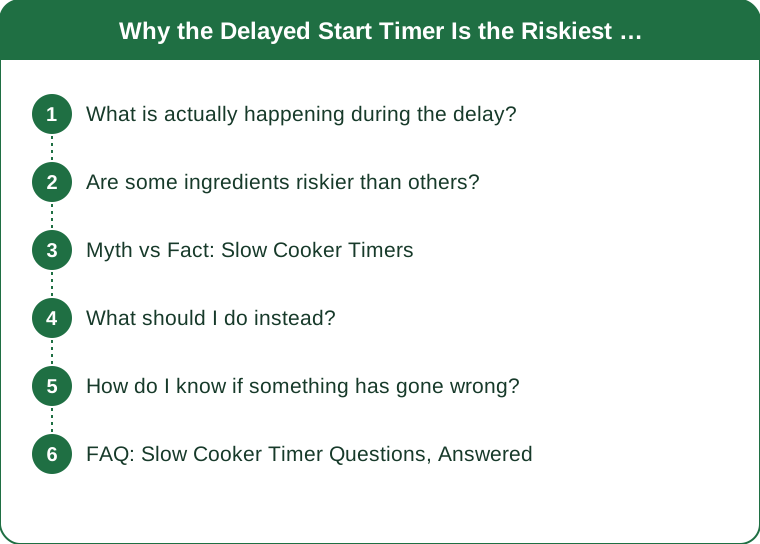
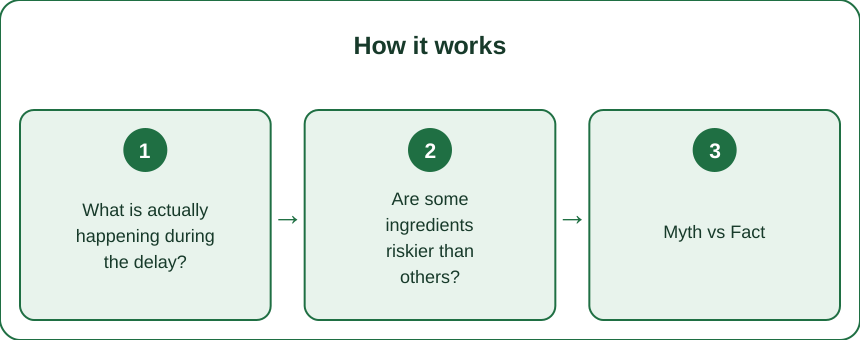
What is actually happening during the delay?
The pot sits at room temperature with raw ingredients in it. That is the entire mechanism - there is no refrigeration, no heating, nothing. Six hours of delay is six hours of ingredients at kitchen temperature.
The danger zone is roughly 5°C to 60°C. Within it, common bacteria can double approximately every 20 minutes under favourable conditions. Six hours is enough for a small starting population to become a very large one.
Cooking kills the bacteria but not everything they leave behind. Some organisms produce heat-stable toxins - staphylococcal enterotoxin is the standard example - which survive normal cooking temperatures entirely. This is why the usual reassurance that heat fixes everything does not fully apply.
Slow cookers heat slowly by design, which extends the problem at the other end. A full pot of cold ingredients can take an hour or more to climb out of the danger zone even after it switches on, and that hour sits on top of your delay.
And a cold start compounds it. Fridge-cold ingredients plus a slow heater plus a delay means the total time in the risky range can easily reach eight hours on a hot summer day.
Are some ingredients riskier than others?
Yes, and the differences are large. Raw poultry is the highest-risk item to leave sitting - campylobacter and salmonella are common on raw chicken and multiply readily at room temperature.
Rice and cooked grains are the ones people forget. Bacillus cereus spores survive cooking and produce toxin as the food sits in the danger zone. Adding pre-cooked rice to a delayed-start pot is one of the higher-risk things you can do with this appliance.
Dairy is straightforwardly unsuitable for delay - it should not be added early to a slow cooker anyway, since it curdles, so this rarely comes up in practice.
Beans have a separate issue entirely. Raw kidney beans contain phytohaemagglutinin, which requires a vigorous boil to destroy and can actually be concentrated by prolonged low-temperature cooking. They need boiling for ten minutes before they go anywhere near a slow cooker, delay or no delay.
Vegetable-only dishes are the lowest risk but still not risk-free, since soil bacteria and spores are present. A two-hour delay with vegetables alone is a fairly different proposition from six hours with chicken thighs - but the safe answer is the same either way.
And warm weather changes all of it. A 26°C kitchen in late August moves everything faster than a 17°C one in November. The same delay is not the same risk across seasons.
Myth vs Fact: Slow Cooker Timers
Myth: the long cooking time kills everything, so the delay does not matter. Fact: it kills the bacteria but not the heat-stable toxins some have already produced. Those are unaffected by hours at slow cooker temperatures.
Myth: if the food smells fine it is fine. Fact: the organisms that cause food poisoning generally do not produce noticeable smell, taste, or appearance changes. Spoilage bacteria are what make food smell bad, and they are largely a different group.
Myth: putting the pot in the fridge overnight solves it. Fact: it helps at the start, but it makes the heat-up phase longer, so the total time in the danger zone may not improve much. Chilling the insert is useful for overnight storage, not for enabling a long delay.
Myth: the keep-warm setting is equally risky. Fact: keep-warm holds food above the danger zone, typically around 70°C or more, which is safe for a few hours. The direction matters completely - warm after cooking is fine, cold before cooking is not.
Myth: slow cookers with a delay function would not include it if it were unsafe. Fact: the function exists and manufacturers generally caveat it in the manual. Most food safety authorities advise against long delays with raw ingredients regardless of what the appliance can do.
Myth: a short delay is just as bad as a long one. Fact: the standard guidance is a two-hour limit at room temperature. A 60 to 90 minute delay is a different proposition from six hours - though it also buys you very little.
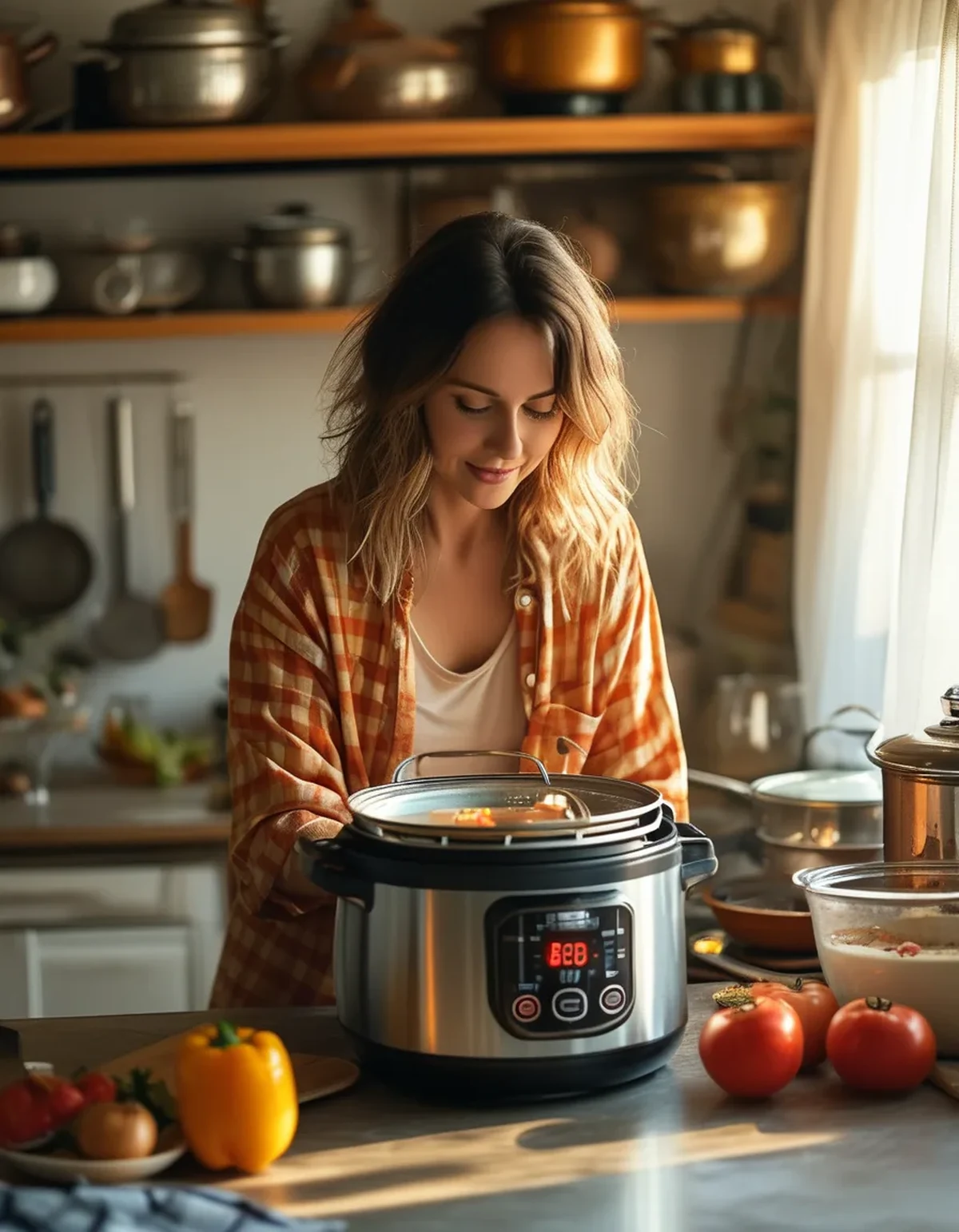
What should I do instead?
Cook then hold, rather than hold then cook. Almost every slow cooker will switch to keep-warm automatically at the end of the cooking time. Set a shorter cook time that finishes before you get home, and let it hold - that is safe and it is what the function is for.
Use a smart plug for genuine timing control. A £10 smart plug lets you start the cooker remotely from your phone at whatever time suits. This is the actual solution to the problem people are trying to solve with the delay button.
Prep the night before, refrigerate, and load in the morning. Everything chopped and in a container in the fridge, tipped into the pot as you leave. The prep is the time-consuming part; the loading takes 90 seconds.
Or cook overnight and refrigerate. Many braises are better the next day anyway, and reheating a finished dish is entirely safe in a way that delaying a raw one is not.
Start with hot liquid to shorten the heat-up. Adding boiling stock rather than cold gets the pot out of the danger zone considerably faster, which is good practice whether or not any delay is involved.
And do not fill it beyond about two-thirds. An overfilled cooker heats more slowly and unevenly - the same principle, applying to the normal cooking process rather than the delay.
How do I know if something has gone wrong?
You mostly cannot tell by looking, which is the whole problem. Food that has spent too long in the danger zone usually looks and smells entirely normal.
The temperature check is the one reliable tool. A cheap probe thermometer showing 75°C or above in the thickest part confirms the cooking was adequate - though it says nothing about what happened before the cooking started.
Watch for the pot never getting properly hot. A slow cooker that has aged or been damaged may not reach the temperature it should. If your low setting never gets a full pot bubbling gently after several hours, test it: fill with water, run on low for eight hours, and check it reads at least 85°C.
When in doubt, throw it out - and that applies to the whole batch, not the parts that look fine. This is not an area to reason your way past a genuine doubt given how little the food is worth relative to being ill.
And symptoms are worth taking seriously. Food poisoning that involves a high fever, blood, severe dehydration, or symptoms lasting more than a couple of days needs medical attention, and so does any case in someone pregnant, very young, elderly, or immunocompromised. This is general information, not medical advice.
FAQ: Slow Cooker Timer Questions, Answered
Is the delay start function on my slow cooker safe to use at all?
For short delays under about two hours with cold ingredients in a cool kitchen, the risk is low. For the six to eight hour delays people actually want to use it for, food safety guidance advises against it.
Is keep-warm after cooking the same risk?
No - the opposite. Keep-warm holds food above the danger zone, around 70°C or more, which is safe for a few hours. Cold-before-cooking is what creates the problem.
Can I put frozen meat in a slow cooker to buy time?
No. Frozen meat extends the time the pot spends heating through the danger zone, which makes the situation worse rather than better. Thaw in the fridge first.
What if I refrigerate the insert overnight?
It starts colder, which helps, but it also takes longer to heat up - so the total time in the risky range does not improve as much as it seems. It is good for storage, not for enabling a delay.
Is a smart plug actually a good alternative?
Yes, and it is the direct fix. It lets you start the cooker at a chosen time from your phone, so the ingredients go in and the heat starts within the safe window.
Will I be able to tell if food has been left too long?
Usually not. The organisms that cause illness generally do not change how food smells, tastes, or looks. That is precisely why the time rule exists rather than a sniff test.
TL;DR:
- A delayed start leaves raw food in the 5 to 60°C danger zone for the whole delay. Standard guidance caps that at two hours.
- Cooking kills bacteria but not all the toxins they have already produced - some are heat-stable and survive slow cooking entirely.
- Slow cookers heat slowly, so the heat-up phase adds another hour or more on top of the delay.
- Highest-risk items: raw poultry and pre-cooked rice. Kidney beans need a separate 10-minute boil regardless.
- Do it the other way round: cook first, let keep-warm hold it. That direction is safe.
- A smart plug is the real solution - remote start at the time you actually want.
You cannot smell or see the problem. That is why it is a time rule and not a judgement call. This is general information, not medical advice.
Keep Reading
This article is for general informational purposes only and is not medical advice. Always consult a qualified health professional for guidance specific to you.